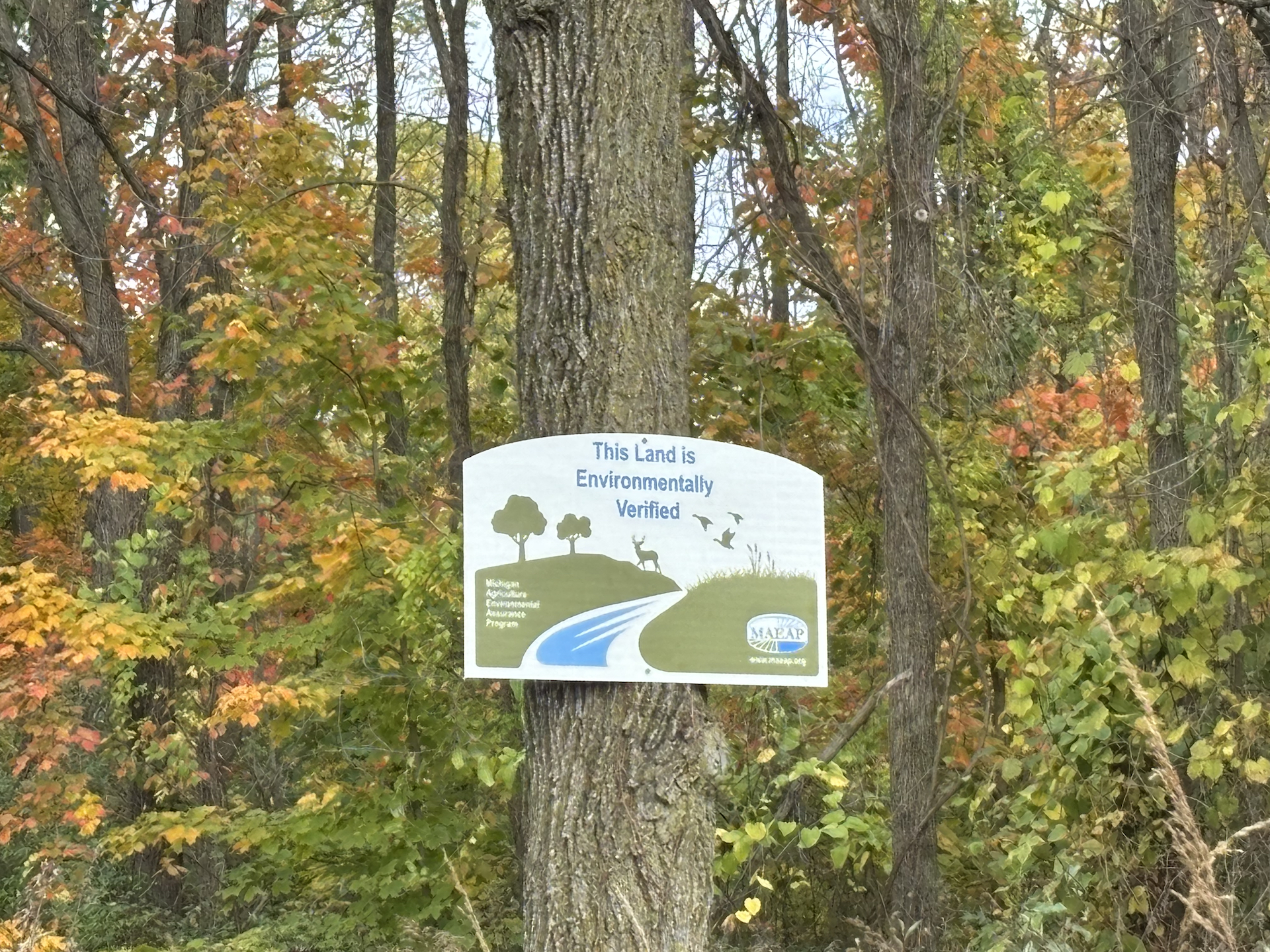
The journey to earn my MAEAP verification began when I visited Susan Beecher’s land in Chelsea on a Wild Ones tour in 2022. Susan had a native meadows, trees, rain gardens, a flourishing ecosystem. My original goal of creating a traditional farm was already quickly evaporating; my California knowledge was no match for Michigan weather and insects. Besides, there is a farm I love a mile down the road that was sustainably growing anything I could grow better than I could grow it. I remember standing in front of Susan Beecher’s MAEAP sign and snapping a photo. “I’ll have to investigate what the heck this is,” I thought. Meanwhile, I killed my lawn, planted native seeds and grasses in its stead, and built a rain garden to filter my roof drainage.
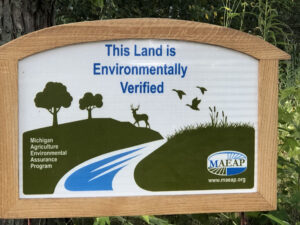
The sign that started it all, gracing the entrance to Susan Beecher’s gorgeous, rewilded property.
In late spring 2023, Emma was visiting from the Monroe Conservation District to approve a mini grant for my rain garden. We hit it off right away. (She told me she had a Hayduke Lives bumper sticker on her personal vehicle, which of course was a truck.) I had already intuitively divided my property into zones, which as it turns out is the first order of business in MAEAP certification. I asked her if she knew anything about this “MAEAP”. “Actually,” she said, “I’m the tech for that in this region.” I had two choices, Emma, explained. MAEAP, it turns out, stands for the Michigan Agriculture Environmental Assurance Program. Emma said I could go for the land verification or the farm verification. I qualified for both. I tentatively went with the farm verification, and I became more attached to the “farmstead” designation moving forward. My farm would predominately be native crops: black walnuts, black raspberries, elderberries, hazelnuts, paw-paws, persimmons. I’d grow annual, more traditional crops in Zone Two. (See previous posts for more on Zones and their purposes.) Flowers also counted as a crop. Had I considered bees, which are considered livestock?
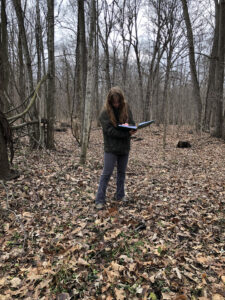
Emma takes notes in Zone 5.
Before long, Emma left the conservation district for a university research job in Toledo, and at the same time the district suffered other staffing losses. I waited as patiently as I could for restaffing, and then one day, months later, I got an email from Levi Couch, my new contact. I would be his first MAEAP verification. We checked the rest of the boxes, which was easy here because I don’t use pesticides or have any farm equipment to speak of. We’re hands on and low tech. A missing water test held us up for a couple months, but finally, on September 25, 2025, a MAEAP supervisor named Josh signed the paperwork. Levi and a new tech, Tina, were here to witness.
Now I had to pick my sign: land or farm verification? We spent a while discussing this. Josh explained that since the sign was intended to educate passers-by, the farm sign would confuse them. There were no rows of crops. There was no hoop house. There was no visible orchard. There was a striking one acre meadow. And since my property is a wetland, which is very special, why not go with the land verification? If my farm looked and acted more like a farm in the future, I could change the sign. I thought hard for a moment. Josh said that it seemed that my priority was habitat. And that was the land verification. “You’re right!” I said. And it was decided.
MAEAP defines my designation this way: “Verification in the Forest, Wetlands, and Habitat System recognizes the sustainable management practices implemented by landowners on their property. FWH verification provides landowners with the a risk assessment targeting all areas of ownership not under traditional agriculture production promoting sustainable forestry, wetlands and non-forest habitat practices.” This suits Whimsy Farm perfectly. And those of you who know me well understand that I tend to delight in being nontraditional!
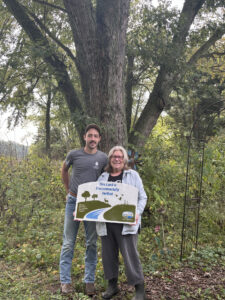
Levi Couch and I with my land verification sign.
Next, I’ll work with Levi on a Land Management System to improve the health of my forest and eradicate native species. Costs for this aren’t covered by the state of Michigan, so he’ll be looking for funding. This is probably a good time to mention my Patreon community. This is one place your money goes when you become a a paid member. My ultimate goal is to be a demonstration farm, where the Monroe Conservation District and others can bring folks who want to rewild and see what is possible. That’s a few years off, but the goal is in sight. Scroll down this page for the Patreon link.
A few days have passed since the verification, but I’m still floaty. The sign isn’t posted out front yet; I need someone to come hang it high on a walnut tree (Tina confirmed it wouldn’t hurt the tree). Meanwhile, it’s in my kitchen where I stare at it more than I should. And a few times a day I celebrate the idyllic fall weather by strolling down my lane, watching the bees feed on the New England Aster, knowing the meadow is teeming with native insects. Birds of all sorts duck in and out of the meadow. At night, the crickets are boisterous.
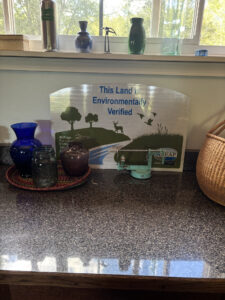
Still life with MAEAP sign. Those vases often hold fresh local flowers, and the apple and pear peeler is for dehydrating, which I do a lot of. The flowers and fruit come from that farm I love that’s right down the road.
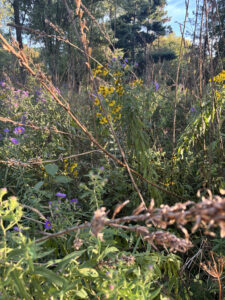
The delicious chaos of a native autumn meadow. New England Aster and sneeze weed are abundant this year.
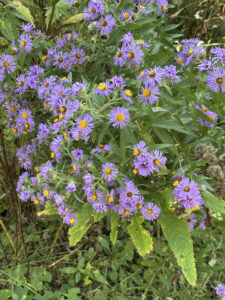
The bees are drinking up the New England Aster.
Thanks to Emma, Jackson, and Levi from the Monroe Conservation District, and thanks to Shelby and Josh from MAEAP. Thanks to Susan Beecher for the inspiration. Thanks to Sawyer and Sarah for their labor and advice along the way. Thanks to my sons for helping when they visit. I’m a happy nontraditional farmer.